

Permanent (real) accounts are accounts that transfer balances to the next period Bookkeeping for Consultants and include balance sheet accounts, such as assets, liabilities, and stockholders’ equity. These accounts will not be set back to zero at the beginning of the next period; they will keep their balances. On the statement of retained earnings, we reported the ending balance of retained earnings to be $15,190. We need to do the closing entries to make them match and zero out the temporary accounts.
- We will debit the revenue accounts and credit the Income Summary account.
- For each temporary account there will be a closing journal entry.
- On the statement of retained earnings, we reported the ending balance of retained earnings to be $15,190.
- This means that the current balance of these accounts is zero, because they were closed on December 31, 2018, to complete the annual accounting period.
- The T-account summary for Printing Plus after closing entries are journalized is presented in Figure 5.7.
- The balance in the Income Summary account equals the net income or loss for the period.
Closing Entry: What It Is and How to Record One
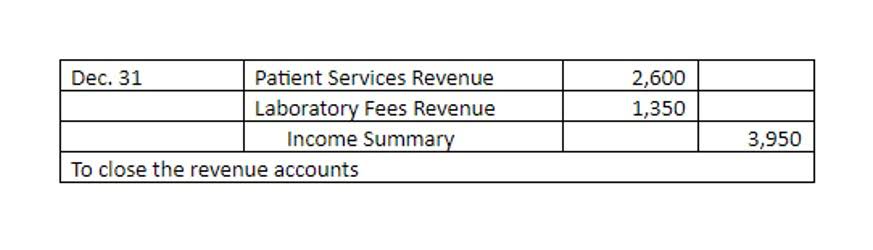
To further clarify this concept, balances are closed to assure all revenues and expenses are recorded in the proper period and then start over the following period. The revenue and expense accounts should start at zero each period, because we are measuring how much revenue is earned and expenses incurred during the period. However, the cash balances, as well as the other balance sheet accounts, are carried over from the end of a current period to the beginning of the next period.
Four Steps in Preparing Closing Entries
- The balances of these accounts are eventually used to construct the income statement at the end of the fiscal year.
- And so, the amounts in one accounting period should be closed so that they won’t get mixed with those in the next period.
- The trial balance shows the ending balances of all asset, liability and equity accounts remaining.
- These posted entries will then translate into a post-closing trial balance, which is a trial balance that is prepared after all of the closing entries have been recorded.
- The revenue and expense accounts should start at zero each period, because we are measuring how much revenue is earned and expenses incurred during the period.
- For corporations, Income Summary is closed entirely to «Retained Earnings».
The third entry requires Income Summary to close to the Retained Earnings account. To get a zero balance in the Income Summary account, there are guidelines to consider. For our purposes, assume that we are closing the books at the end of each month unless otherwise noted.

Closing Journal Entries

Interim periods are usually monthly, quarterly, or half-yearly. To close the drawing account to the capital account, we credit the drawing account and debit the capital account. which of the following is not a closing entry These accounts are be zeroed and their balance should be transferred to permanent accounts. The income statement summarizes your income, as does income summary. If both summarize your income in the same period, then they must be equal.
Step 4: Close withdrawals to the capital account
- However, some corporations use a temporary clearing account for dividends declared (let’s use «Dividends»).
- To get a zero balance in the Income Summary account, there are guidelines to consider.
- The balance in Income Summary is the same figure as what is reported on Printing Plus’s Income Statement.
- Take note that closing entries are prepared only for temporary accounts.
- Remember that net income is equal to all income minus all expenses.
In summary, the accountant resets the temporary accounts to zero by transferring the balances to permanent accounts. The retained earnings account balance has now increased to 8,000, and forms part of the trial balance after the closing journal entries have been made. This trial balance gives the opening balances for the next accounting period, and contains only balance sheet accounts including the new balance on the retained earnings account as shown below. If a temporary account has a debit balance it is credited to bring it to zero, and the retained earnings account is credited to balance the closing entry. Likewise, if a retained earnings temporary account has a credit balance, it is debited to bring it to zero and the retained earnings account is credited. The closing entries are dated in the journal as of the last day of the accounting period.
- The income summary account is then closed to the retained earnings account.
- As mentioned, temporary accounts in the general ledger consist of income statement accounts such as sales or expense accounts.
- You might be asking yourself, “is the Income Summary account even necessary?
- An accounting year-end which is not the calendar year end is sometimes referred to as a fiscal year end.
- Temporary accounts include all revenue and expense accounts, and also withdrawal accounts of owner/s in the case of sole proprietorships and partnerships (dividends for corporations).