
Surprising fact: a majority of wallet-related losses in DeFi are not due to phishing emails or stolen seed phrases but to «blind signing» of transactions whose downstream effects the user never inspected. For power users moving funds across chains and interacting with complex smart contracts, that single mechanical failure — signing before you know the exact token flows and fees — is a far bigger operational risk than many people expect. Rabby Wallet’s explicit design response centers on transaction simulation, a feature that reshapes everyday security trade-offs for multi‑chain DeFi activity.
This guest post is written for US-based DeFi power users who already understand wallets, gas, and approvals but want a clearer mental model for choosing and operating a secure multi‑chain wallet. I’ll trace the historical problem Rabby addresses, explain the mechanism of transaction simulation and risk scanning, compare the practical trade-offs against alternatives, and finish with decision heuristics and near-term signals to watch.
From single‑chain UX to multi‑chain risk: how we got here
Early wallets were simple key stores with a basic signer. As DeFi composability grew, users began approving contracts, batching swaps, and bridging assets across multiple EVM chains. Each additional chain multiplies the state space: tokens, decimals, approvals, gas tokens, and contract addresses differ. That complexity created two failure modes: (1) users accidentally approving unlimited token allowances to malicious or buggy contracts; and (2) signing transactions that, once executed, produced unexpected token movements or high fees. Power users accept some operational complexity — but they need tools that make that complexity legible before committing a signature.
Rabby’s place in this arc is pragmatic: it is open‑source, non‑custodial, and designed by DeBank to be a safer front end for cross‑chain DeFi interactions. The wallet runs as a Chromium extension (Chrome, Brave, Edge), mobile apps (iOS, Android), and desktop clients (Windows, macOS), with hardware wallet compatibility for Ledger, Trezor, and others. But its defensive architecture is what matters most for risk‑sensitive activity: simulation, pre‑transaction scanning, approval revocation, and automatic network switching.
Mechanics: what transaction simulation actually does
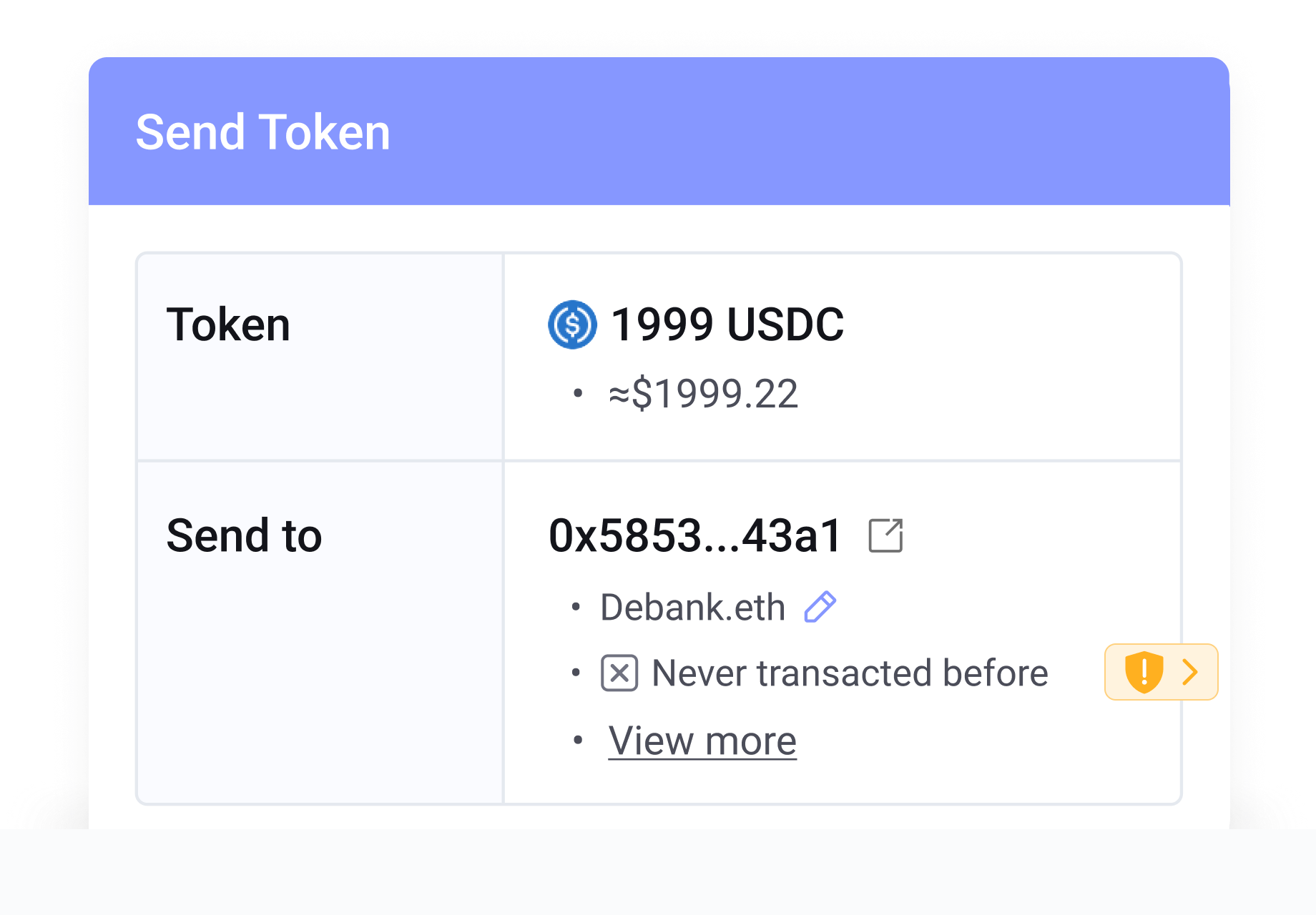
Transaction simulation is not just an explanatory pop‑up. Mechanically, Rabby executes a dry‑run of the signed transaction against a node or an emulator to compute the exact state delta the transaction would produce: token balances before and after, gas used and the fee cost, and any internal message calls that would transfer assets. The result is presented to the user as concrete estimated balance changes and fee numbers — turning an opaque hexadecimal payload into actionable facts.
Why this matters: smart contracts often bundle multiple operations in a single transaction (token approvals, swaps across DEXs, liquidity provision, cross‑contract calls). Simulation answers the question «If I sign this, what tokens will I lose or gain, and how much fiat will I pay in fees?» rather than leaving you to infer from a raw transaction blob. That’s a clear causal mechanism reducing blind signing errors.
Security engine and complementary defenses
Beyond simulation, Rabby runs a pre‑transaction risk scanner that flags known indicators: interactions with addresses tied to past exploits, suspicious approval requests, or non‑existent recipients. It also offers built‑in approval revocation — an operational control that helps limit exposure if an allowance is granted too broadly. For institutions or high‑value users, integrations with multi‑sig and custody solutions such as Gnosis Safe and Fireblocks let teams combine behavioral defenses with organizational controls.
Important limitation: simulation is as good as the data and the execution environment. Off‑chain relays, mempool front‑running, or fast‑moving contract upgrades can create conditions where the simulated outcome diverges from the final execution. Rabby reduces probability of surprise, but does not eliminate protocol risk, oracle manipulation, or zero‑day contract exploits. The 2022 Rabby Swap exploit (about $190k) is a reminder that a wallet tool is only one layer; protocol security and responsible contract design remain crucial.
Trade-offs: why simulation isn’t free or sufficient
There are costs and boundaries to this design. Simulation increases latency in the signing flow and requires reliable RPC endpoints or emulators; degraded node connectivity can produce stale or failed simulations. It also creates a UX trade‑off: power users who value speed may find extra confirmations annoying. More subtly, simulation shifts trust: you now trust the wallet’s simulation engine and its data sources. Rabby mitigates this via open‑source code under an MIT license, allowing audits — but open code does not equal perfect security.
Another practical constraint is Rabby’s current lack of an in‑wallet fiat on‑ramp and no native staking interface. For US users who want a one‑stop experience — buy with fiat, stake, and manage approvals — Rabby requires chaining out to other services for fiat and staking. In many DeFi workflows this is acceptable: most power users prefer separating custody/purchase rails from their transaction signing environment. But for some flows (onboarding new users, custody-limited teams) those gaps matter.
How Rabby compares to common alternatives
MetaMask, Trust Wallet, and Coinbase Wallet each offer strong ecosystem reach. Rabby differentiates by default in two ways: automatic network switching and built‑in simulation/scanning. Automatic network switching removes a frequent operational error — trying to use a dApp while on the wrong chain — while simulation closes the blind signing gap that MetaMask historically did not address as explicitly. For institutional users, Rabby’s integrations with hardware wallets and multi‑sig platforms make it a pragmatic bridge between consumer UX and enterprise controls.
Nevertheless, alternatives may be preferable for users who value embedded fiat purchases or native staking within the wallet. The decision is therefore contextual: if your day‑to‑day risk is signing complex composable transactions, simulation is high value. If your workflow centers on buying tokens with a card and staking in a single app, the missing on‑ramp and staking features are meaningful friction.
One sharper mental model and a reusable heuristic
Mental model: treat a wallet like an «execution policy engine» rather than a mere key store. The engine has three axes — visibility (how much of the transaction’s effect you can see), reversibility (how easily you can revoke approvals or recover from mistakes), and organizational controls (multi‑sig, hardware). Rabby moves the visibility axis substantially to the right via simulation and scanning; approval revocation and hardware support improve reversibility and organizational posture.
Decision heuristic for power users: if you execute multi‑step DeFi flows (bridging, yield farming, complex swaps), prioritize wallets that maximize visibility and reversibility even at a modest speed cost. If your primary need is smooth fiat onboarding and one‑click staking, prioritize wallets with built‑in rails and accept weaker pre‑transaction signals. For many US‑based traders and teams, a hybrid stack — custody or fiat purchase elsewhere, Rabby for signing and DeFi interactions — will be the practical sweet spot.
What to watch next
Signals that would change this analysis: (1) Rabby or competing wallets integrating on‑ramps without weakening the simulation and security posture; (2) broader adoption of standardized transaction simulation APIs across wallets and relayers (would reduce fragmentation and raise baseline safety); (3) material changes in how mempool front‑running or MEV is mitigated at the infrastructure level, which could alter the reliability of pre‑transaction simulations. Each signal affects the trade‑offs between immediacy and safety.
For immediate action: use hardware wallets with Rabby for high‑value positions, enable approval revocation checks after interacting with new dApps, and treat simulation output as a necessary but not sufficient check against protocol or oracle risk.
For those who want to try the wallet and read developer documentation, see the project page for installation and source details: rabby.
FAQ
How reliable is Rabby’s transaction simulation?
Simulation is a strong guardrail: it converts opaque transaction payloads into concrete balance and fee estimates. Its reliability depends on accurate RPC responses and current on‑chain state; it cannot protect against a contract vulnerability revealed only after deployment or against off‑chain manipulations like oracle attacks. Treat simulation as a probabilistic reduction of blind signing risk, not an absolute guarantee.
Can Rabby replace a hardware wallet or multisig for institutional security?
No. Rabby integrates with hardware wallets and multisig services; it complements them. For institutional use you should combine Rabby’s visibility and revocation tools with hardware keys and multi‑sig policies to achieve defense‑in‑depth.
Does Rabby support all chains and tokens I might use?
Rabby supports over 90 EVM‑compatible chains including Ethereum, BNB Chain, Arbitrum, Optimism, Polygon, and Avalanche. Non‑EVM chains are out of scope. Token recognition depends on on‑chain metadata and indexers; you may occasionally need to add custom tokens by contract address.
What about privacy and open‑source auditability?
Rabby is open‑source under an MIT license, which enables audits and community review. Privacy implications are typical of browser wallets: extensions may read dApp contexts; RPC providers log requests. For privacy‑sensitive workflows use dedicated RPCs and consider separating identities across browser profiles or devices.